

Dubai Real Estate Market – March 2026
Introduction
What did Dubai's real estate market deliver in March 2026? Following a quarter shaped by policy adjustments, the market responded with a rational pattern of 'lower transaction volume, stable prices.' While transaction activity softened, prices of core assets remained resilient and rents continued to rise. This reflects not merely a short-term adjustment, but a clear signal of a maturing market.
01 Market Overview:
Short-Term Cooling, Enduring Value Resilience
In March 2026, Dubai's real estate market showed signs of pace adjustment, stable pricing, structural differentiation, and strong resilience in core assets. Transaction volumes declined temporarily, while prices and rents remained at elevated levels. Supported by an improving policy environment and a well-balanced supply-demand dynamic, Dubai continues to stand out as a key global destination for asset allocation.
02 Macro Environment:
Policy Support Sustains Development Momentum
In March, Dubai introduced a AED 1 billion economic stimulus package to stabilize the market, while a AED 2 billion large-scale residential project was launched in Dubai South. Regulations on co-living were further refined. In Q1 2026, construction permits increased by 12% year-on-year, and total construction area surged by 48%, reflecting a steady development pace and strong long-term fundamentals.
03 Sales Market:
Off-Plan Dominance, Stable Pricing Amid Lower Volume
In March, 12,046 residential transactions were recorded, with a total value of approximately AED 35 billion. Off-plan properties accounted for 9,256 transactions (nearly 80%), with an average price of AED 2,104 per sq.ft., showing a slight month-on-month increase. Secondary market transactions declined, while the average price held firm at AED 2,053 per sq.ft., reinforcing overall market confidence.
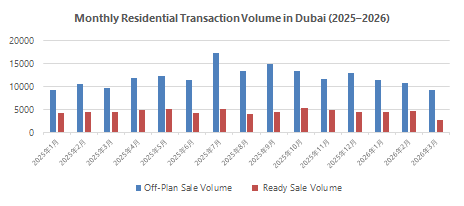
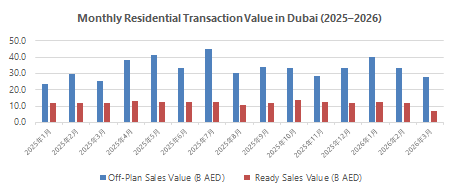
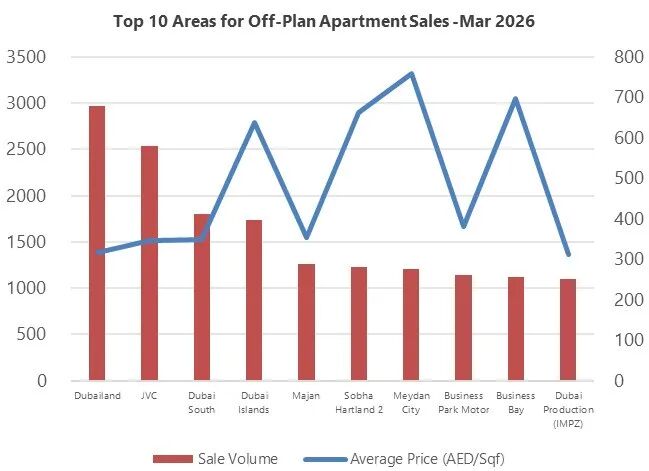
Regionally, off-plan apartment transactions were driven by high-volume areas such as Dubailand, JVC, and Dubai South, while high-value zones including Dubai Islands, Business Bay, and Sobha Hartland 2 contributed significant capital inflows.
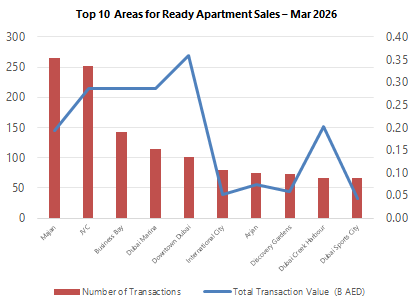
In the secondary apartment market, outer areas led in transaction volume, with Majan and JVC ranking first and second, reflecting strong demand for affordable, high-value communities.
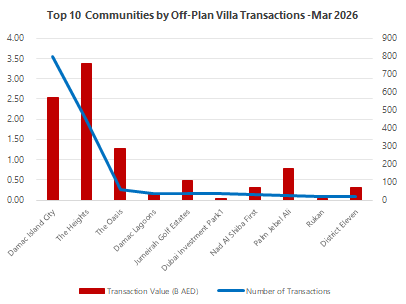
In the villa segment, off-plan transactions were dominated by large-scale developments. Damac Island City led with 801 units sold, while The Heights ranked first in transaction value. Premium communities such as The Oasis and Palm Jebel Ali achieved the highest unit prices, reinforcing their luxury positioning.
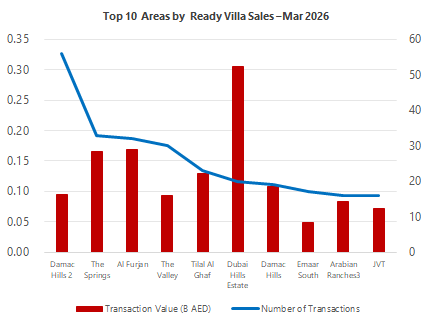
In the secondary villa market, established communities showed strong liquidity. Damac Hills 2 led in transaction volume, while Dubai Hills Estate recorded an average price of AED 3,207 per sq.ft., highlighting the resilience of prime villa assets.
Top 10 Developers by Transactions
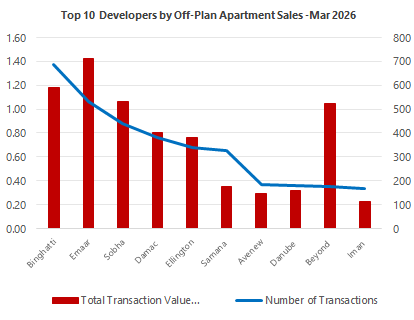
In the off-plan apartment segment, Binghatti ranked first in transaction volume with 686 units, demonstrating strong sell-through capability. Emaar led in transaction value with AED 1.42 billion, reflecting strong demand for premium large-format units. Meanwhile, Beyond achieved an average price of AED 4,358 per sq.ft., with an average unit price of around AED 6 million, firmly positioning itself in the high-end segment.
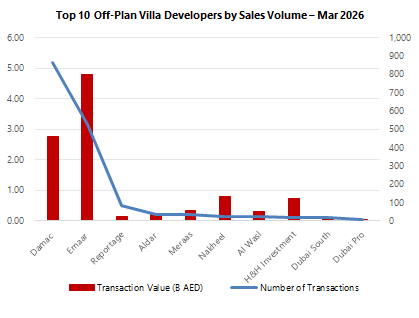
In the off-plan villa segment, Damac led in transaction volume with 865 units, driven by mid-market large-scale developments. Emaar ranked first in transaction value with AED 4.78 billion, showcasing strong absorption of high-ticket assets. Developers such as Nakheel and H&H Investment recorded significantly higher unit prices, highlighting the premium value of scarce villa assets.
04 Land Market:
Periodic Adjustment, Core Plots Remain Resilient
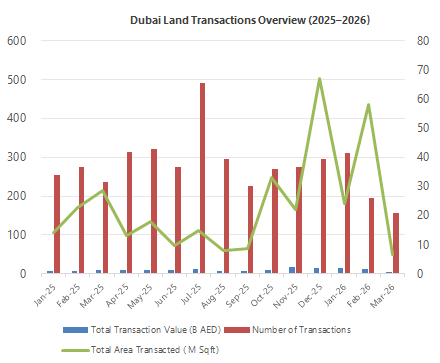
Land transactions fell to a 15-month low, totaling AED 4.09 billion. The market displayed a pattern of stability in core areas and volume concentration in peripheral zones. Industrial and outer districts contributed the bulk of transaction volume, while prime areas such as Al Sufouh accounted for 33% of total transaction value, demonstrating strong resilience of scarce land assets.
05 Rental Market:
Lower Activity, Stable Yields
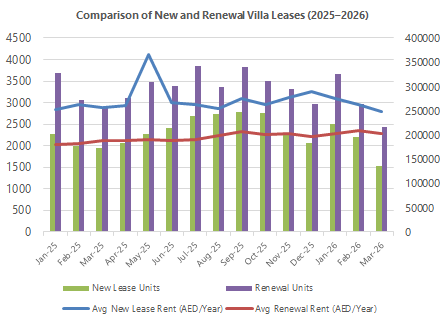
Rental activity declined, but rental levels remained firm. The average annual rent for new apartment leases reached AED 82,424, while renewal rents increased by 5.7% year-on-year. Villa rents saw a slight increase, supported by a higher proportion of high-end properties. Mature communities continued to drive volume, while prime locations maintained premium pricing, ensuring stable rental demand and returns.
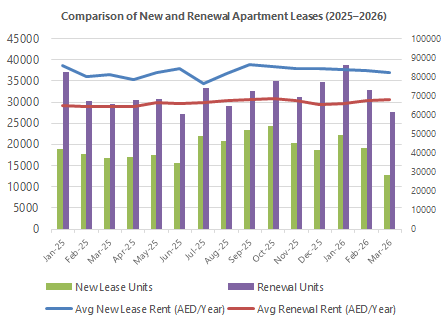
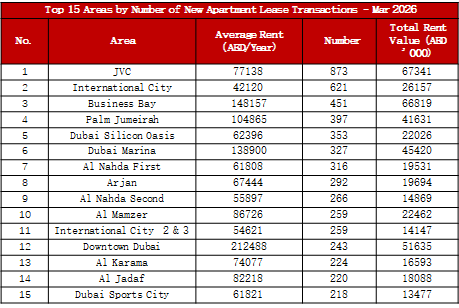
For apartments, new lease transactions were led by JVC, International City, and Business Bay, while Downtown Dubai recorded an average annual rent of AED 212,488, setting a clear benchmark for prime areas.
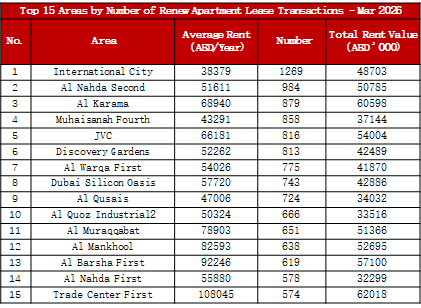
In renewal leases, mature residential areas such as International City, Al Nahda Second, and Al Karama remained dominant, reflecting stable tenant retention and strong demand for value-for-money communities.
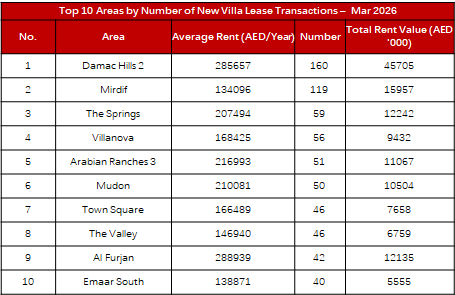
For villas, new lease transactions were concentrated in Damac Hills 2 and Mirdif, catering to mainstream demand.
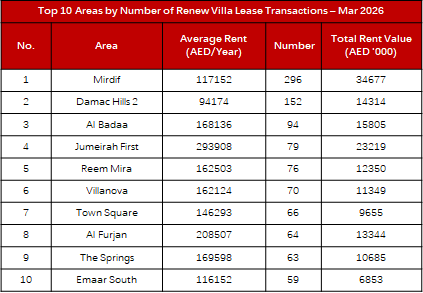
In renewal leases, Mirdif led significantly, while Jumeirah First recorded an average annual rent of nearly AED 294,000, underscoring the strength of prime villa rental markets.
06 Market Summary:
Short-Term Fluctuations, Long-Term Opportunity
Dubai's real estate market experienced a mild adjustment in March. However, the underlying fundamentals—policy support, sufficient supply, and continuous global capital inflows—remain unchanged. Core assets continue to demonstrate strong price resilience. This period presents a strategic window for investing in prime locations and high-quality properties, reaffirming Dubai real estate as a stable and reliable asset class.