

Dubai Real Estate Market — October 2026
Dubai’s real estate market in October 2026 did not see gains across the board. Instead, it sought a new balance between macroeconomic resilience, diverging land market performance, residential adjustments and stronger rental compliance.
01 | Macroeconomy: The Non-Oil Economy Supports Long-Term Demand
The UAE’s real GDP reached AED 961.9 billion in the first half of 2026, up 0.4% year on year. Non-oil GDP grew by 1.8%, increasing its share of the overall economy from 78.1% to 79.2%. Trade, finance and insurance, construction, manufacturing and real estate remained key contributors, with economic diversification continuing to underpin long-term property demand in Dubai.
Dubai’s real GDP stood at approximately AED 473 billion in the first half, down 2.3% year on year. Real estate activities accounted for approximately 11.8% of real GDP, while the sector’s gross value added at current prices reached around AED 65.1 billion, up 5.4% year on year. Dubai recorded approximately AED 379 billion in property sales during the first nine months, the second-highest total on record for that period. Meanwhile, September’s non-oil private sector PMI rose to 54.5, its highest reading of 2026.
At the city level, Dubai approved the Urban Centres Development Plan, with investment exceeding AED 2 billion to develop six main urban centres and 42 secondary centres, covering approximately 12% of the city’s area. By 2040, the plan aims to increase the proportion of residents living near metro stations from 52% to 74% and is expected to add approximately AED 20 billion to property values in the targeted areas.
02 | Land: Transaction Value Rises as Volume and Area Decline
Dubai’s land transactions totalled approximately AED 3.824 billion in October, up 8.9% month on month. However, the number of transactions fell 4.5% to 148, while the total area transacted declined 29.2% to approximately 5.4053 million sq ft. The rise in value alongside lower transaction volume and area indicates that large deals played a greater role in supporting the market.
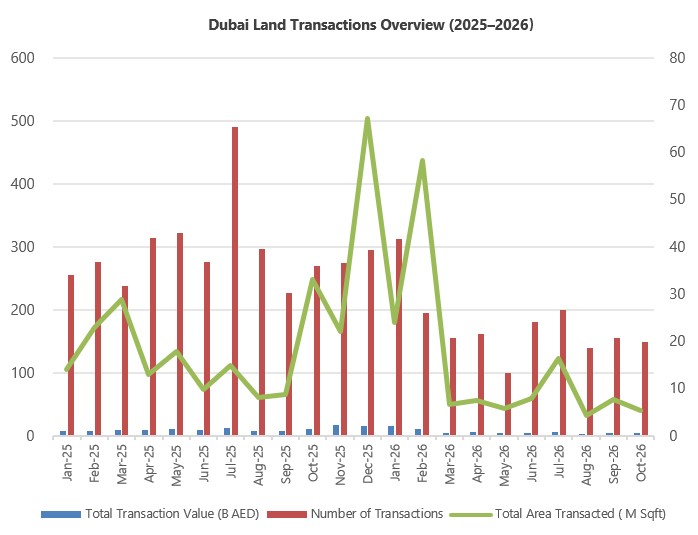
A single AED 600 million transaction in Barsha Heights accounted for approximately 15.7% of the month’s total value, while the five largest transactions represented around 31.1%. By area, Jebel Ali Hills led with 16 transactions, followed by Al Rowaiyah First and Dubai Industrial City with 10 each. Al Rowaiyah First, Barsha Heights and Palm Jebel Ali together contributed approximately 50.4% of total transaction value. This points to a market in which emerging and industrial areas supported transaction volume, while high-value plots drove transaction value.
Land transactions with registered gross floor area (GFA) totalled 28, with a combined value of approximately AED 1.082 billion and total GFA of around 1.6361 million sq ft. This represented a marked contraction from September’s 53 transactions, AED 1.154 billion in value and 3.08 million sq ft of GFA.
A measured perspective remains necessary: October’s transaction value was still 40.9% below July’s level, while transaction volume and area were lower by 26.0% and 66.8%, respectively. The current performance is better characterised as a selective recovery; a broad-based rebound has yet to be confirmed.
03 | Residential: Off-Plan Transactions Contract While Ready Property Prices Remain Resilient
Dubai recorded 7,067 off-plan residential transactions in October, down 47.5% year on year, alongside 3,700 ready property transactions, down 31.3%. Average prices stood at 1,626 for off-plan properties and 2,026 for ready properties, with the latter increasing 10.2% year on year.
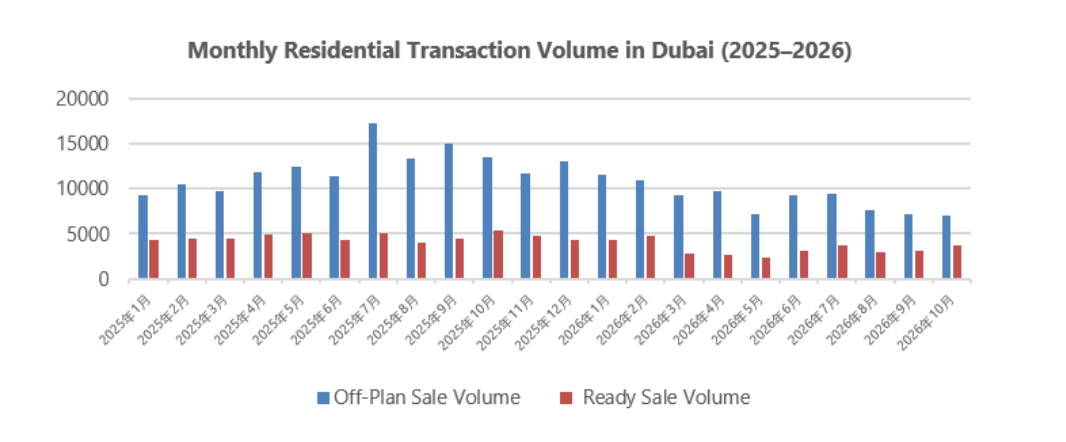
The contraction in off-plan transactions reflects buyers’ growing sensitivity to delivery timelines, developer credentials and future supply. Resilient ready property prices, meanwhile, indicate continued demand for established communities and properties available for immediate occupation or rental.
The market is shifting from transaction-led momentum towards a stronger emphasis on how well a property’s features match its price. Location, product quality and delivery certainty matter more than ever.
04 | Rental: Stronger Compliance Is Reshaping the Market
Regulatory developments deserve particular attention in the rental sector. Dubai’s Rental Disputes Center reported 2,350 amicable settlements during the first nine months of 2026, involving approximately AED 401 million. With an average processing time of just six days, the efficiency of rental dispute resolution improved further.
New shared housing regulations have also taken effect. Dubai Municipality issued the Planning and Building Requirements Guide for Shared Housing to implement Law No. 4 of 2026, permitting compliant shared housing in more than 44 areas.
The rules require a minimum bedroom area of five square metres per resident in shared accommodation for individuals, prohibit families and individuals from sharing the same accommodation, and set standards for fire safety, hygiene and other requirements. Existing properties have been granted a one-year compliance period starting from 8 September 2026. These measures will raise compliance requirements in the affordable rental segment and help reduce overcrowding and unauthorised subletting.
Overall, large transactions supported Dubai’s land transaction value in October, although transaction volume and area continued to decline. Off-plan residential activity contracted, while ready property prices remained relatively firm. In the rental market, faster dispute resolution and new shared housing rules are accelerating the shift towards stronger compliance.
The fundamentals supporting long-term demand remain intact, but the near-term market places greater demands on location selection, product positioning and cost control. For market participants, the current environment favours carefully selected locations and close attention to transaction activity over simply chasing price increases.